
Protecting a building starts with understanding what you’re trying to prevent. Are you concerned about someone entering with a weapon, an unauthorized visitor following an employee through a secured door, or both?
Weapons detection systems and access control systems address different security risks. Weapons detection systems screen for potentially dangerous objects, while access control systems manage who can enter restricted spaces. Security mantraps can provide an additional layer by physically controlling passage through an entrance and, when configured with metal detection, restricting access in response to a detection alarm.
Understanding these differences helps schools, hospitals, government buildings, and commercial facilities select security technology that addresses their actual vulnerabilities.
What Is the Difference Between Weapons Detection vs. Access Control?
Weapons detection identifies potential threats carried into a screening area. Access control determines whether a person is authorized to enter a space.
Both technologies support facility security, but their functions are fundamentally different.
A weapons detection system, such as the CEIA OPENGATE 2.0, screens people for designated metallic threats as they pass through a detection lane. When an alarm occurs, security personnel can follow established procedures to investigate and respond.
An access control system typically uses credentials, badges, biometrics, or other authorization methods to determine whether a door should unlock.
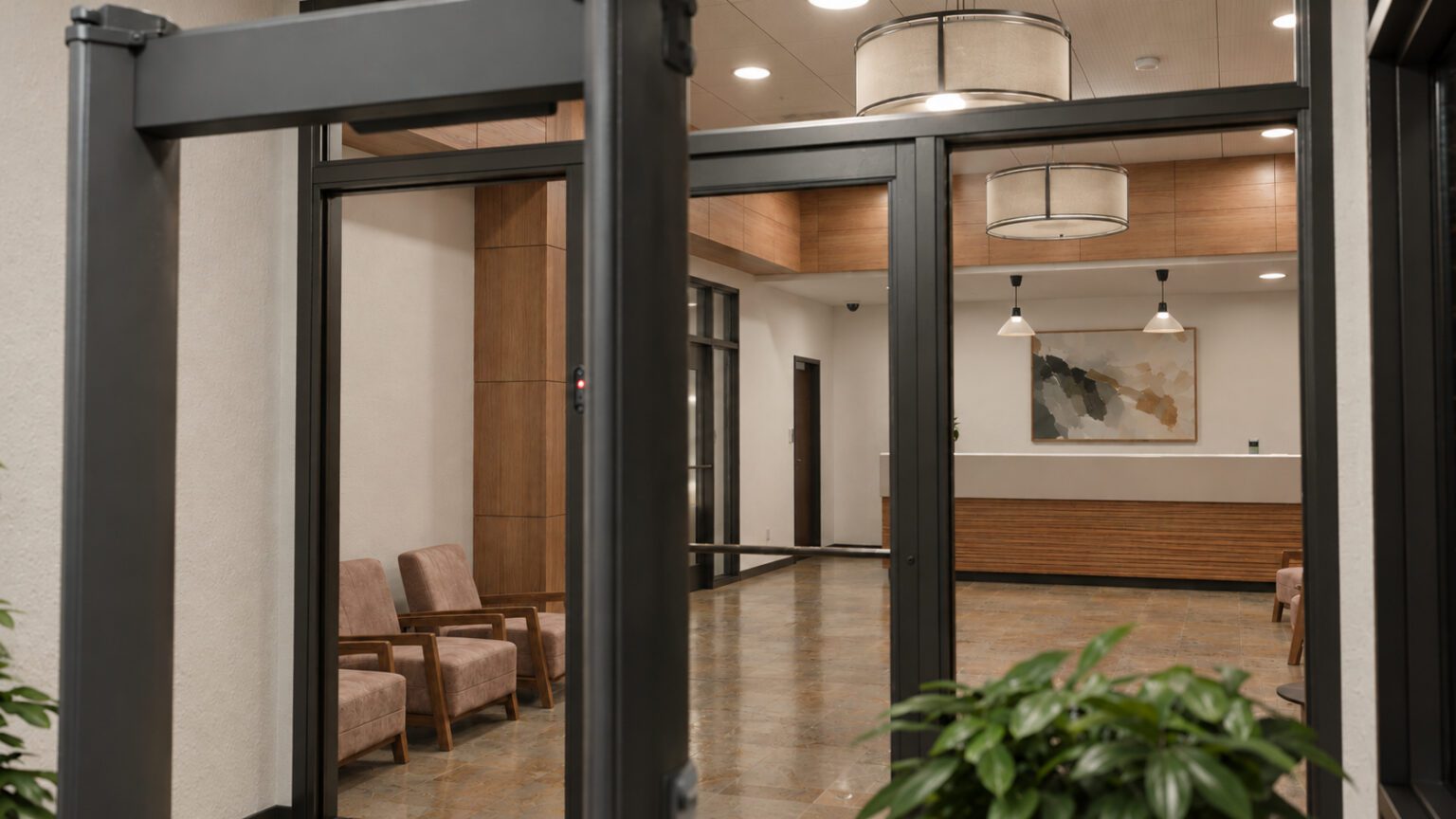
A security mantrap, also known as an interlocking door system, security vestibule, or Safety Entrance, provides an additional level of physical access control. Coordinating the operation of two doors creates a controlled transition between public and restricted areas.
| Security Solution | Primary Purpose | Key Limitation |
|---|---|---|
| OPENGATE 2.0 | Screens people for designated metallic weapon threats with high-throughput, portable detection | Does not independently verify identity or physically prevent entry |
| Traditional Walk-Through Metal Detectors | Screen for metallic objects according to their detection settings | Require response procedures and do not independently control access |
| Access Controlled Doors | Restrict entry based on credentials or other authorization methods | Do not inherently detect weapons or prevent someone from following an authorized person |
| Security Mantraps / Safety Entrances | Control movement through interlocking doors and enforce configured entry procedures | Do not inherently detect weapons unless screening technology is integrated |
The appropriate system depends on the security risk, the people entering the building, available staffing, and the level of control required.
What Problems Do Walk-Through Weapons Detection Systems Solve?
Walk-through weapons detection systems are designed to help security teams identify potential weapon threats before individuals enter a protected area.
These systems are particularly useful in facilities that welcome large numbers of students, employees, visitors, patients, or event attendees.
Common applications include:
- Schools and universities: Screening students, visitors, and event attendees at designated entrances.
- Hospitals and healthcare facilities: Screening public entrances, emergency departments, and other areas where weapons present a concern.
- Government buildings and courthouses: Supporting entrance screening procedures for employees and visitors.
- Stadiums and entertainment venues: Screening high volumes of attendees while managing entry lines.
- Commercial buildings: Adding weapons screening to reception areas, lobbies, or designated security checkpoints.
How Does OPENGATE 2.0 Work?
OPENGATE 2.0 is a portable weapons detection system manufactured by CEIA.
Unlike traditional arch-style metal detectors, OPENGATE uses two freestanding columns to create a screening lane. The system is designed to detect designated metallic weapon threats while allowing people to pass through with many common personal belongings. Depending on the configured security level and screening requirements, visitors may be able to keep backpacks, purses, and other belongings with them, reducing the need for divestment.
OPENGATE also offers wireless operation and portability, making it suitable for facilities that need to relocate screening checkpoints or deploy equipment temporarily.
Important consideration: Weapons detection systems require appropriate placement, operating procedures, alarm resolution, and trained personnel. Detection capabilities depend on the equipment, configuration, threat characteristics, and operating environment.

How Do Security Mantraps Prevent Unauthorized Entry?
Unlike a standard access-controlled door, a mantrap can enforce a defined sequence of entry conditions before allowing someone to proceed.
For example, a facility may require an individual to:
- Present an authorized credential.
- Enter the controlled vestibule.
- Allow the first door to close and secure.
- Complete any additional verification or screening required by the facility.
- Proceed through the second door after the system grants access.
The exact sequence depends on the facility’s requirements and the technologies integrated into the system.
Can Mantraps Prevent Tailgating and Piggybacking?
Isotec Safety Entrances use interlocking door controls to restrict passage according to the facility’s programmed security requirements. Where single-person passage is required, additional occupancy detection, verification technology, and appropriate system configuration may be necessary.
This makes security mantraps valuable for locations requiring a higher level of control over who enters restricted areas.
Can Weapons Detection Systems Prevent Unauthorized Access?
For example, when a walk-through weapons detector alarms, the facility’s response depends on its security procedures and surrounding infrastructure. A staffed screening checkpoint may use trained personnel to redirect the individual, conduct secondary screening, or deny entry.
For facilities requiring physical control of the entrance, weapons detection technology can be integrated with compatible access control equipment. Isotec offers the IDEAL OG access lock as an integration option for OPENGATE deployments. The system is designed to support automated door locking in response to detection events, subject to the installation’s configuration and applicable life safety requirements.
The important question is whether your facility needs to detect a potential threat, control physical entry, or accomplish both functions.
Can Security Mantraps Include Metal Detectors?
In an appropriately configured system, the metal detector communicates with the entrance controls. If a designated metallic threat triggers an alarm, the system can be programmed to prevent the next stage of entry and initiate the facility’s required response. Potential applications include:
- Correctional facilities and secured government buildings
- High-security financial institutions
- Sensitive areas within healthcare facilities
- Critical infrastructure and data centers
- Commercial facilities with restricted or high-value areas

Metal detection capability, detection sensitivity, access logic, and alarm handling must be specified for the particular application.
Can an Existing Entrance Be Converted Into a Security Mantrap?
However, not every entrance is appropriate for conversion. Available space, door hardware, accessibility, emergency egress requirements, and the desired screening process all influence feasibility.
When Does a Building Need Both Weapons Detection and Access Control?
Scenario 1: A Public School With a High-Volume Main Entrance
A school wants to screen students and visitors for weapons while keeping arrival lines manageable. In this environment, screening efficiency, student flow, available personnel, and emergency procedures may be central considerations.
A portable, high-throughput weapons detection system such as OPENGATE may be appropriate for its primary screening checkpoint, while credential-based access control can separately protect staff-only entrances, administrative offices, or other restricted areas.
Scenario 2: A Corporate Building With Restricted Offices
A corporate facility has a public lobby but wants to prevent unauthorized visitors from entering secured offices or sensitive areas. Card readers may allow unauthorized individuals to follow employees through unguarded doors.
A security mantrap can add physical separation and enforce a controlled entry sequence. If weapon screening is also required, compatible metal detection can be incorporated into the entrance design.
Scenario 3: A Courthouse or High-Security Government Facility
Weapons detection can support the public screening process, while security mantraps can control movement between spaces with different access permissions. Depending on the facility’s requirements, these technologies can operate as separate security checkpoints or as integrated components of a broader entrance solution.

Which Security Solution Is Best for Your Industry?
| Facility Type | Common Concern | Potential Solutions |
|---|---|---|
| Schools & Universities | Weapons screening and high-volume entry | OPENGATE, access-controlled doors |
| Hospitals & Behavioral Health Facilities | Public safety, restricted access, controlled movement | Weapons detection, safety entrances, credential systems, IDEAL systems |
| Corporate Offices | Tailgating, visitor access, sensitive information | Safety entrances, credential-controlled doors, IDEAL systems |
| Courthouses & Government Buildings | Weapons screening, unauthorized entry, restricted zones | Metal detection, safety entrances, integrated access control, RAD ROSA, Omnilert, TruePort |
| Data Centers & Critical Infrastructure | Unauthorized entry and protection of sensitive assets | Safety entrances, identity verification, specialized screening, IDEAL, RAD ROSA, Omnilert |
| Stadiums & Event Venues | High-volume weapons screening | OPENGATE, staffed screening checkpoints, Omnilert, TruePort |
| Financial Institutions | Restricted access, personnel protection, asset security | Safety entrances, integrated metal detection |
These are starting points for a security assessment rather than universal recommendations. Different areas of the same facility may require different levels of security.
How Do You Choose the Right Entrance Security System?
Before purchasing a weapons detection system, security mantrap, or access control upgrade, evaluate the following questions. Which one is right for me when it’s weapons detection vs. access control? Take some time considering the following:
1. What are you trying to prevent?
Identify whether your primary concerns involve prohibited weapons, unauthorized visitors, tailgating, access to sensitive areas, or several overlapping risks.
2. Who needs to enter the building?
Consider employees, students, patients, contractors, delivery personnel, and public visitors. The appropriate screening and authorization procedures may differ for each group.
3. How many people use the entrance?
A checkpoint serving thousands of people during a short arrival period has different throughput requirements from a restricted entrance used by a small number of authorized employees.
4. What happens when an alarm occurs?
Determine who responds, where secondary screening occurs, whether access must be temporarily restricted, and how people can safely exit.
5. Can the solution work with your existing infrastructure?
Evaluate available doors, space, access control equipment, security staffing, and opportunities for retrofit or integration.
6. What are the accessibility and emergency requirements?
All proposed security measures must account for accessible entry and exit, emergency evacuation, applicable building and fire codes, and the facility’s operating procedures.
7. How will the system be operated and maintained?
Consider employee training, system testing, maintenance, technical support, changing security requirements, and future expansion.
Evaluating these questions helps ensure the equipment selected addresses operational needs as well as security objectives.
Building a Layered Security Strategy
The value of a layered approach comes from defining how these components work together.
For example, a facility might use portable weapons screening at its public entrance, credential-controlled doors for employee areas, and a metal-detection-integrated Safety Entrance at a particularly sensitive location. This allows security measures to match the risk and operational requirements of each space.
How Isotec Helps Facilities Evaluate Entrance Security
Our solutions include:
- OPENGATE 2.0 weapons detection for portable, high-throughput screening.
- Safety Entrances and security mantraps for controlled entry into restricted areas.
- Integrated walk-through metal detection for applications that require screening as part of an entrance control sequence.
- Retrofit and integration solutions designed around existing facility infrastructure. Whether you’re evaluating weapons screening for a public entrance, improving access control for a restricted area, or considering a security mantrap with integrated detection, the starting point is understanding your building’s specific risks.
Contact Isotec Security to discuss your facility’s entrance security requirements and explore the appropriate combination of weapons detection and access control technologies.
No. Metal detectors identify metallic objects according to their detection capabilities and settings. Security mantraps use interlocking doors to control passage between areas. A mantrap can integrate metal detection to combine screening with controlled access.
A security mantrap equipped with compatible metal detection can be configured to deny entry when the detector alarms. Its effectiveness depends on detection capability, system configuration, installation, and response procedures. A mantrap without weapons detection does not automatically identify concealed weapons.
OPENGATE is primarily a weapons detection system. It does not independently verify identity or authorize entry. It can be used alongside access control technologies, including compatible locking solutions, as part of a layered security approach.
The appropriate solution depends on the building’s risk level. Credential-controlled doors may be sufficient for some areas. Where tailgating or unauthorized passage creates a greater risk, a security mantrap with appropriate verification and occupancy controls can provide stronger physical access enforcement.
Yes. Compatible systems can be integrated so that detection events influence door operation, alarms, or security response procedures. The specific integration must account for equipment compatibility, system programming, emergency egress, and applicable safety requirements.
They can be appropriate for selected areas where controlled access is important. Hospitals may use security mantraps to protect sensitive departments or restrict movement into secured spaces. Schools may use access control at staff-only or restricted entrances, while weapons detection may be more appropriate for public screening checkpoints. The choice depends on each facility’s layout, risk assessment, and operating requirements.
A badge-access door verifies a credential before unlocking, but may allow additional people to enter while the door is open. A mantrap uses an interlocking two-door arrangement to create a controlled transition. With appropriate verification and occupancy controls, it can provide stronger protection against unauthorized passage.
Yes, some existing door configurations can be converted into a security mantrap. Feasibility depends on door placement, hardware compatibility, available vestibule space, system controls, accessibility, and life safety requirements. A site evaluation helps determine whether a retrofit or new entrance is the better option.